


The Science of Flossing
Your toothbrush does a lot. It does not do everything.
Cleaning between your teeth reaches surfaces a toothbrush cannot clean effectively. But what actually happens there? Does flossing really prevent gum disease? What about cavities, bleeding gums, heart health? And is traditional floss even the best tool?
The science is more interesting, and more nuanced, than "just floss every day."
Adding an interdental cleaner to toothbrushing may reduce gingivitis and plaque more than brushing alone. Much of that clinical evidence is short-term and rated low or very low certainty. Interdental brushes may outperform floss in spaces where a brush fits, while conventional floss remains particularly useful for tight contacts.
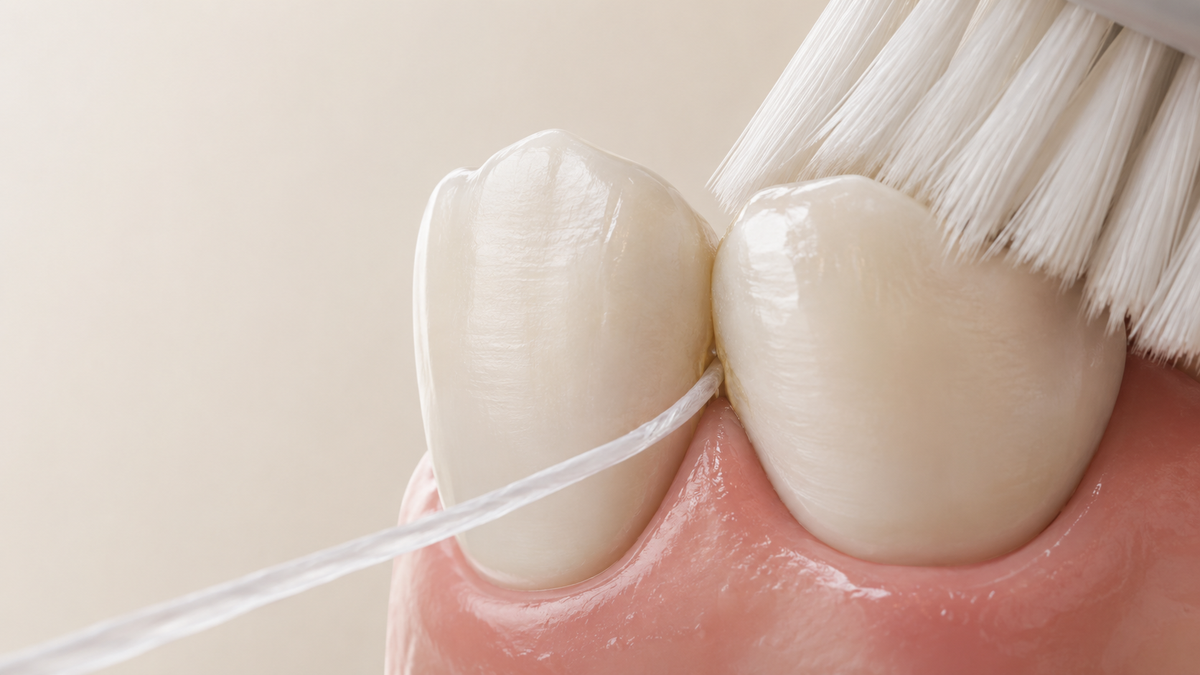
The space your toothbrush misses. Toothbrush bristles cannot effectively clean every tight surface between neighbouring teeth, which is why interdental cleaning exists.
Your teeth have surfaces a toothbrush doesn't clean well
A tooth may look like one simple object, but bacteria experience it as a landscape of surfaces, grooves, margins and protected spaces.
One of those protected environments is the interproximal area, where neighbouring teeth face one another. Bristles clean the exposed outer, tongue-side and chewing surfaces, but they do not effectively enter many tight contacts between teeth.
That matters because dental plaque is not simply food stuck on your teeth. It is a biofilm: a structured community of microorganisms adhering to oral surfaces. Left along the gumline, it can provoke an inflammatory response in the surrounding gum tissue.
The purpose of floss is not primarily to pull out a visible piece of spinach. Its main job is mechanical biofilm disruption.
When floss is wrapped around the side of a tooth and moved along its surface, it physically disturbs plaque in an area a toothbrush may not adequately reach. The same objective applies when an interdental brush, an appropriately designed pick, or a water flosser is used instead.

Floss works by contact. It is most useful when it hugs the tooth surface rather than simply passing vertically through the space. NIH guidance recommends curving floss around each tooth and gently moving it along the surface near and slightly beneath the gumline.
The visible part is the smaller part
Removing trapped food is the obvious job, and the one most people notice. The deeper purpose is disrupting a thin, structured bacterial film you cannot see at all.
That distinction explains why "nothing came out, so I must not have needed it" is a misleading test of whether interdental cleaning did anything.
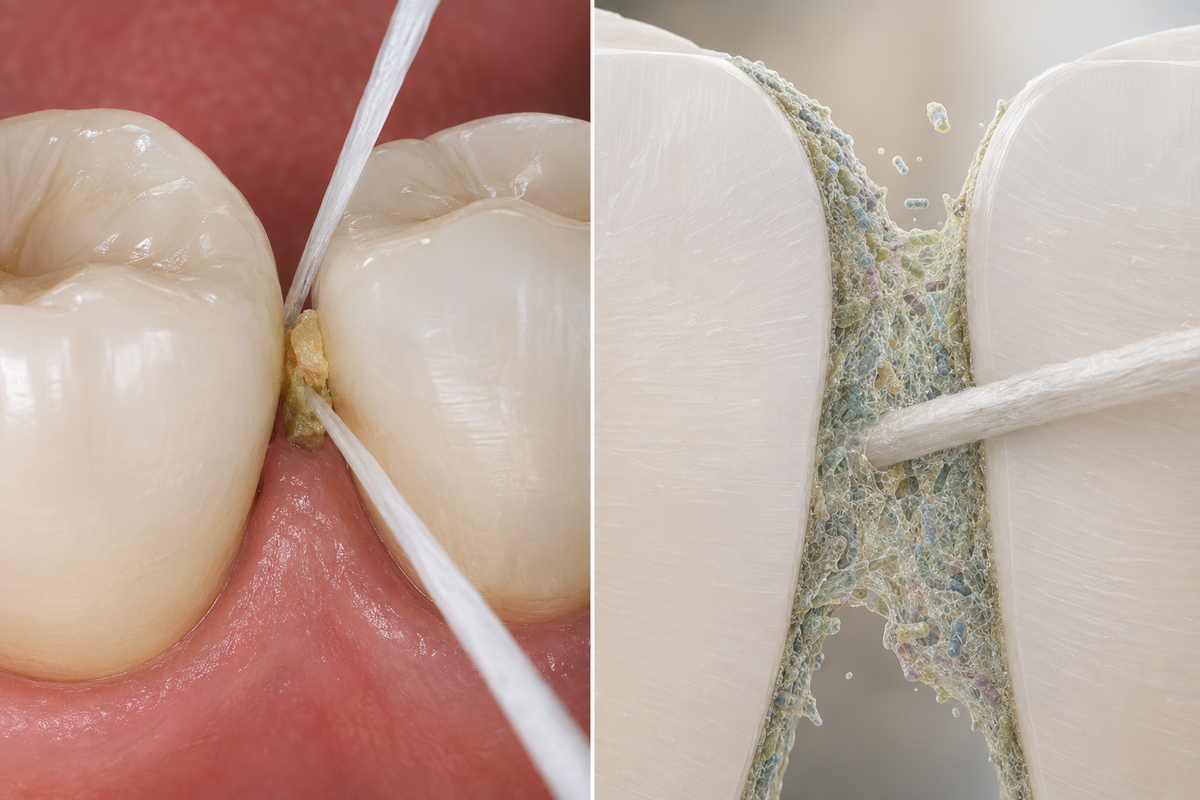
Food removal is the obvious part. Biofilm disruption is the point. Plaque is a structured microbial community, not simply debris.
From plaque to inflammation
Plaque forms continually. When it accumulates around the gumline, the immune system reacts to the bacterial challenge. The earliest common result is gingivitis, inflammation limited to the gum tissue, and it is generally reversible once effective plaque control is restored.
This is why gums that bleed during brushing or interdental cleaning should not automatically be read as "my gums are too delicate to clean." Easy bleeding is itself a common sign of inflammation.
Plaque left undisturbed can also mineralise into calculus, commonly called tartar. Once hardened, ordinary brushing and flossing cannot remove it and professional instrumentation is required.
Gingivitis and periodontitis are not the same condition. Gingivitis affects the gums and is generally reversible. Periodontitis involves destruction of the structures supporting the teeth, including attachment and bone. Periodontitis is multifactorial, so it would be inaccurate to suggest that not flossing automatically causes it.
Flossing is not a magical shield against gum disease. It is one method of controlling a biological trigger in a location that is difficult to clean.

Inflammation exists on a spectrum, but progression is not inevitable. Plaque-induced gingivitis can generally be reversed with effective oral hygiene. Periodontitis is a more complex disease involving loss of tooth-supporting tissue and requires professional treatment.
Should flossing hurt?
No. Forcefully snapping floss into the gum tissue can injure it. Ease it through the contact instead.
Does bleeding mean I should avoid the area?
Not automatically. Bleeding is a common sign of gingival inflammation, though persistent bleeding warrants professional assessment.
Yes, with qualifications.
To definitively prove that a behaviour like flossing prevents periodontitis or tooth loss, researchers would need large groups whose cleaning could be accurately monitored for years. Periodontitis takes time to develop, home technique varies enormously, adherence is hard to verify, and withholding interdental-care advice for long periods raises real study-design problems. So most trials measure shorter-term outcomes such as plaque and gingivitis instead.
That is not the same as "floss doesn't work." It means the research question is harder than it sounds, and that the quality of the flossing itself matters a great deal.
Disrupting plaque between teeth
Brushing does not effectively reach many tight contacts. That a second tool is needed for those surfaces is well supported by established biology and professional guidance.
Reducing gingivitis and bleeding gums
A major Cochrane review found adding floss to brushing may reduce gingivitis versus brushing alone. Certainty was rated low, most trials were short, and effects were modest.
Preventing cavities between teeth
The 2019 Cochrane review found no randomised trials testing home interdental devices against interproximal caries. One older review found roughly a 40% reduction from professionally performed flossing in children with low fluoride exposure, not from ordinary self-flossing.
Protecting heart and whole-body health
A 2025 analysis of 18,801 US adults found daily flossers had lower cardiovascular prevalence and mortality. It was observational, not a randomised trial, so it cannot show that floss caused those outcomes.

Not every claimed benefit has the same level of evidence. The strongest direct case for routine interdental cleaning is plaque and gingival-health control. Long-term evidence for cavities, periodontitis and systemic outcomes is less direct.
What about heart health and the rest of the body?
A 2025 analysis of 18,801 adults from US NHANES data found that people who reported daily flossing had a lower prevalence of cardiovascular events and lower cardiovascular mortality than people reporting no flossing, even after adjusting for several demographic and lifestyle factors.
That sounds striking. But it was an observational study, not a randomised flossing trial. People who floss daily may differ from those who don't in many ways that are hard to measure fully: health awareness, preventive care, diet, smoking, income, access to dentistry, medication adherence. An association cannot establish that floss itself prevented heart attacks.
Good oral health is part of good overall health, but flossing has not been proven to function as a cardiovascular treatment.
Research continues into the relationships between periodontal inflammation, oral microorganisms, systemic inflammation, diabetes and cardiovascular disease. Those relationships are medically important. They should not be converted into the simplistic claim that flossing prevents heart disease.
Different mouths need different tools.
Perhaps the most important evolution in this field is recognising that flossing and interdental cleaning are not synonymous. For some mouths string floss is excellent. For others it is unnecessarily difficult.
A 2026 patient-centred consensus generally favours interdental brushes where anatomy permits, while recognising different tools for different clinical situations. Individual preference and dexterity matter too, because a theoretically excellent product is not much use when someone cannot, or will not, use it consistently.

Different mouths need different tools. Current recommendations favour personalised interdental cleaning rather than assuming one device is ideal for everyone.
Your teeth contact very tightly
String floss or dental tape
Thin floss can pass through spaces where a brush cannot fit.
You have noticeable spaces between teeth
Interdental brush
Evidence suggests brushes may outperform floss for some plaque and gingivitis outcomes where sufficient space exists.
History of periodontitis or larger interdental spaces
Interdental brushes, sized by a dental professional
Attachment loss can create spaces that string floss does not clean as effectively as an appropriately sized brush.
Limited hand dexterity
Water flosser, floss holder, or another easier-to-handle device
Current consensus specifically recognises oral irrigators as an option for people with limited dexterity.
You dislike string floss enough that you never use it
Whichever appropriate alternative you will actually use
Preference and usability are now considered important parts of personalised interdental care. A theoretically excellent tool is not useful if it stays in the drawer.
A 2023 meta-analysis covering 16 randomised trials and 1,258 participants found power-driven interdental cleaners reduced interdental bleeding when added to brushing, with plaque results more variable and outcomes broadly comparable to flossing in several comparisons. Participants often preferred the powered devices. The lesson is not that water flossers are universally better. It is that the best interdental tool is the one that fits your anatomy, clinical needs, abilities and routine well enough to be used effectively.
How to floss so the floss actually contacts the tooth
Technique matters because floss does not clean a surface merely by entering the space.
NIH guidance is to gently ease floss through the contact, curve it into a C shape around the side of one tooth, and move it up and down along that tooth near the gumline. Then adapt it to the neighbouring tooth and repeat. Snapping floss forcefully into the gum tissue can cause pain and trauma.
Wrong mental model: get the floss between my teeth. Better mental model: wipe both hidden tooth surfaces.
That single change in how the technique is understood makes the purpose of floss far more intuitive.
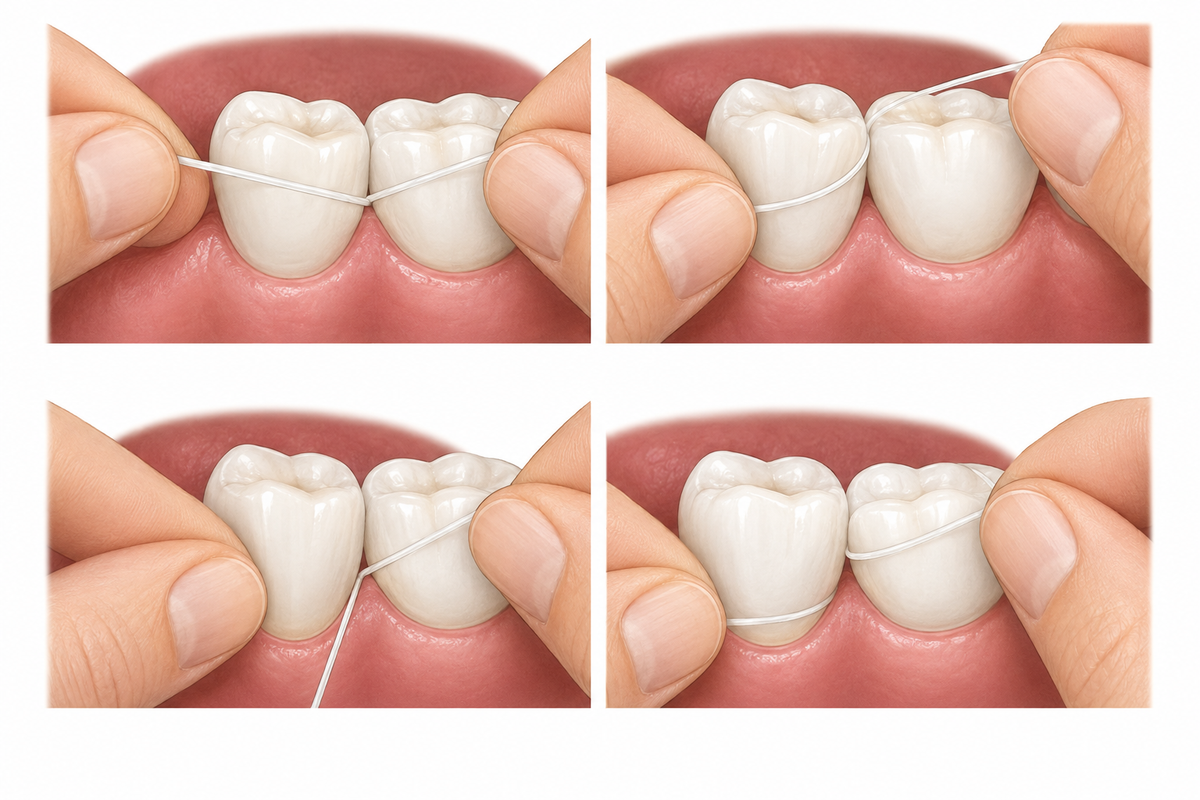
Don't just pass through the contact. Clean the tooth. Adapt the floss around one tooth at a time rather than repeatedly snapping it vertically into the gum.
How often should I clean between my teeth?
Once a day, alongside brushing twice daily. Morning or night matters far less than consistency.
Floss first or brush first?
Either is acceptable when both are done thoroughly. One small crossover trial favoured flossing first, but that is not strong enough to make it a rule. Do whichever helps the habit stick.
What flossing does not do
It does not remove established tartar. Hardened calculus requires professional removal.
It does not replace twice-daily brushing with fluoride toothpaste. Brushing and interdental cleaning address overlapping but different surfaces, and fluoride provides an important anticaries effect that cleaning alone does not.
It does not guarantee you will never develop periodontitis. Periodontal disease is multifactorial, and established periodontitis requires professional diagnosis and treatment.
And on current evidence it would be inaccurate to claim that flossing has been proven to prevent heart attacks, dementia, diabetes or other systemic diseases.
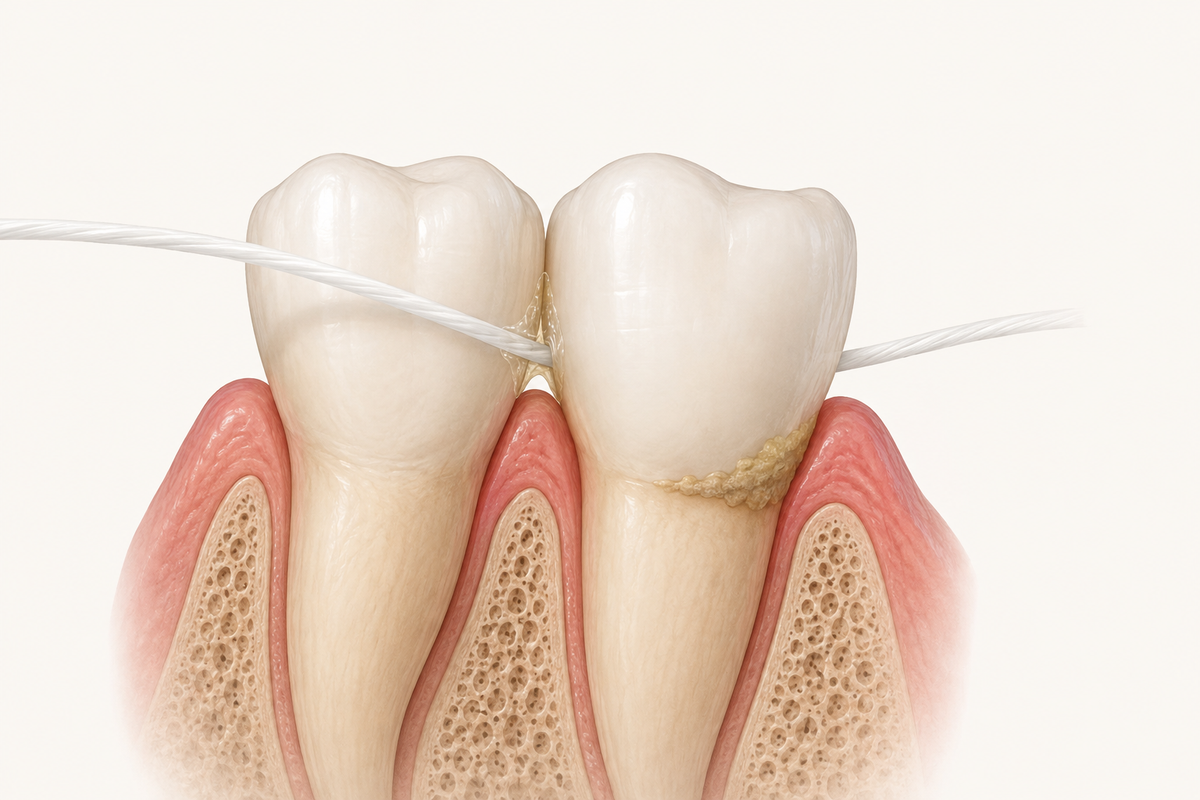
Floss disturbs soft biofilm. It does not remove hardened calculus. Once tartar has formed, professional instrumentation is required.
The goal isn't floss. The goal is a clean interdental environment.
The science of flossing is not that a piece of string possesses some unique health property. The science is about biofilm control.
Bacteria accumulate on surfaces that are difficult to reach. Gum tissue responds to that accumulation. Mechanical cleaning disrupts the biofilm. Toothbrushes do not effectively clean every tight interdental surface, so a second tool is needed for those areas.
For tight contacts, that tool may be floss. For wider spaces, an interdental brush may work better. For someone with limited dexterity, a water flosser or an easier-to-handle device may make more sense.
Clean between your teeth regularly, with the right tool, used the right way.

The goal isn't floss. The goal is a clean interdental environment.
Our approach to oral-health science
We distinguish biological plausibility from demonstrated clinical outcomes. We prioritise systematic reviews, clinical guidelines, randomised trials and established public-health sources, and we identify when an association does not prove causation. Dental research evolves, and recommendations should be individualised with a dentist or dental hygienist.
Worthington et al., Cochrane Database of Systematic Reviews, 2019
Floss or interdental brushes added to brushing may reduce gingivitis and plaque versus brushing alone. Evidence generally low to very low certainty; outcomes mostly short-term. Interdental brushes may outperform floss.
NIDCR, "Do I Really Need to Floss?", reviewed 2024
Flossing addresses areas brushing cannot reach and disrupts plaque. NIDCR explicitly acknowledges that large, long-term flossing studies are limited.
American Dental Association, Dental Floss and Interdental Cleaners, updated August 2026
Recommends once-daily interdental cleaning while acknowledging the limitations of the clinical evidence, and notes that device choice should be individualised.
Thomassen et al., International Journal of Dental Hygiene, 2026
Expert consensus recommends daily interdental cleaning, generally prefers interdental brushes where appropriate, and stresses personalisation by disease, anatomy, dexterity and preference.
Hujoel et al., Journal of Dental Research, 2006
Professionally administered flossing on school days was associated with roughly a 40% reduction in interproximal caries among children with low fluoride exposure. Ordinary self-flossing did not show the same benefit.
Edlund et al., Clinical and Experimental Dental Research, 2023
Meta-analysis of 16 RCTs and 1,258 participants: power-driven interdental cleaners reduced bleeding and often achieved outcomes comparable with flossing. Participants frequently preferred the powered devices.
Sanz et al., EFP S3 Periodontitis Guideline, 2020
Modern periodontal treatment includes behavioural change, supragingival biofilm control, inflammation management, professional instrumentation and ongoing supportive care.
Philip et al., JADA, 2025
Observational NHANES analysis: frequent flossing associated with lower cardiovascular disease prevalence, mortality and CRP. The design cannot demonstrate that flossing caused those outcomes.
Mazhari et al., Journal of Periodontology, 2018
Small randomised crossover trial favoured flossing before brushing for interdental plaque removal and interdental fluoride concentration. A sidebar finding, not a headline conclusion.
Last reviewed: [DATE - update whenever this page changes materially]
This page is general oral-health education, not medical or dental advice, and it is not a claim about any specific product. Persistent bleeding, swelling, gum recession, loose teeth or pain while chewing should be evaluated by a dentist or dental hygienist.